Interstellar Visitors: Oumuamua, Borisov, and Atlas
In this blog, we will be talking about interstellar visitors. If you don’t know what they are, let me be your guide.
So, the interstellar visitors are celestial bodies that come from another galaxy, solar system, or anywhere else. They can be asteroids, comets, meteoroids, or an alien spaceship too.
Hehe, just joking. If we ever get to know that it is an alien spaceship, we will let you know so that you can prepare tea for them.
So, jokes aside, here is what interstellar visitors are. Till today’s date, we have three interstellar visitors named:
- 1I/OUMUAMUA
- 2I/BORISOV
- 3I/ATLAS (You can read about it by clicking this link: 3I/ATLAS: The Interstellar Visitor)
Oumuamua
Oumuamua is up to 400 meters long and 10 times as long as it is wide. Its ratio is the greatest of any asteroid or comet found in our solar system.
What surprises us more is that this comet is so elongated, unlike other comets, which can also give us new clues about the formation of other solar systems.
On 9 September 2017, it passed closest to the Sun. Despite this, it never showed signs of a coma (a coma is the nebulous cloud around the nucleus of a comet). By 2019, most scientists and astronomers confirmed that this comet was a natural object.

- Where did it come from and what explains its strange motion?
As I said earlier, we know it doesn’t belong to our solar system. But its path suggests that it came from a young system of stars, as its incoming speed was similar to the stars in our neighboring systems.
We have mentioned more about its trajectory in articles like “Gods of Gap” and “3I/ATLAS.” So we won’t go into more detail here, but for your idea:
From what scientists predicted, it changed its path. There are several reasons for this, which in simple words are:
- The Sun warmed the comet.
- It released tiny amounts of gas, which gave it a little push and hence changed its path.
Logically, there is no scientific evidence of alien technology, engines, or fuel.
- What is it made of?
Generally, comets are made up of a lot of dust, but this comet was not from our solar system. Scientists could not conclude much about it, as it is not possible to detect its material from observations alone. Based on observations, it probably contained carbon monoxide and carbon dioxide gases, which are less likely to produce a coma or tail. - Where is it now?
January 2018 was the last time we saw Oumuamua… and we can no longer see this comet with our telescopes.
2I/Borisov
- Characteristics and Discovery
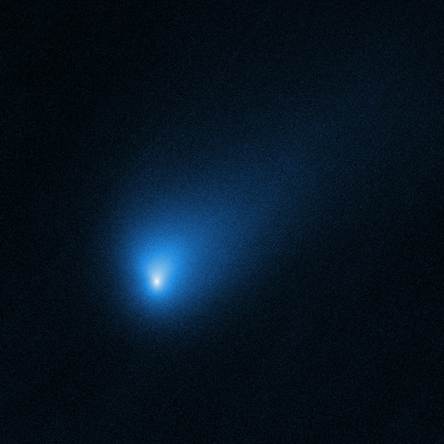
It was discovered by amateur astronomer Gennady Borisov on 29 August 2019 with his homemade telescope. He spotted the object, named it Borisov, and it turned out to be the second interstellar comet.
2I/Borisov is about nine football fields long, or approximately 0.61 miles, which seems small. Scientists found that Borisov’s carbon monoxide concentration is much higher than that of an average comet in our solar system.
- Where did it come from?
The ratio of carbon monoxide to water shows that it came from a cold place, likely a type of Kuiper belt. Hubble observations also suggest that it originated from a common type of star in our Milky Way galaxy. - What is it made of?
According to NASA, it has a high content of CO. Its composition, apart from that, is very similar to other comets in our solar system. It contains water, CO, CO₂, dust particles, and some organic compounds. - Where is it now?
As of November 2025, 2I/Borisov is in the constellation Ara with equatorial coordinates roughly Right Ascension = 17h 58m, Declination = –53° 35′. It is moving away from the Sun on a hyperbolic trajectory and will eventually exit the Solar System.
I won’t be talking about 3I/Atlas here since we have already written about it. Check it out!
I hope you found this blog interesting. We will meet you with more blogs like this. Stay tuned, and thank you for reading!
 Orbital Infinity