Wormholes: Real Gateways or Just Sci-Fi Dreams?
Imagine, travelling billions of light years, in mere seconds, from one galaxy to another galaxy, or even to another universe! Crazy right, It almost sounds unreal, but is it? Wormholes are one of the most fascinating and theoretical things in the universe. The question is: are wormholes real things out there, or just a bunch of fancy math that looks cool on paper? The weird part is, Einstein’s theory of relativity actually allows them. The equations don’t say no. But building or even keeping one open? Yeah, that part seems almost impossible.
Where the Idea Came From
Back in 1935, Albert Einstein and Nathan Rosen came up with something strange while playing around with Einstein’s equations. What they found was sort of a “bridge” between two points in space-time — now called an Einstein-Rosen bridge.

Courtesy to iStock.
Think of space-time as a giant stretchy sheet. Every particle, even subatomic particles, make “valleys” of varying depth. More their mass, more broader and deeper their valley is; more their density, more deeper and narrower their valley is. This is called gravity, which pulls us into the valley. The stretchy sheet is in 3 Dimensions (for us), think of it as a foam box.
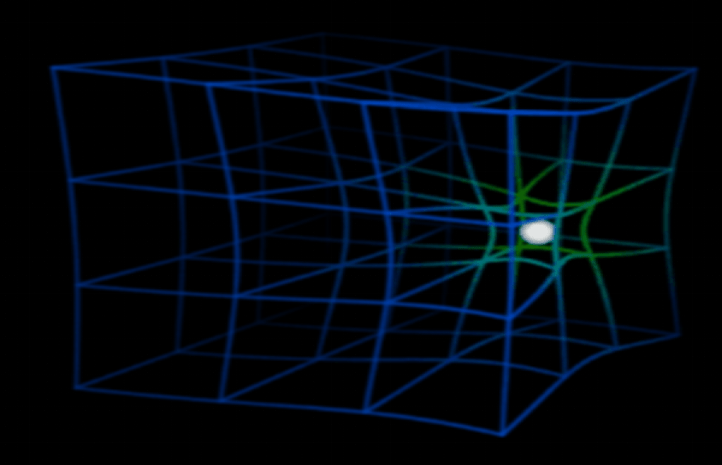
The material of the box, or the sheet, is the 4th Dimension, that is time. Now imagine if there are two massive objects, which made huge valleys. What if you were to poke a hole in their valley’s bottommost point and then connect them? Boom! You have a wormhole. Being a puncture in the sheet, the valley’s soil and rocks ( equivalent to space itself) tries to push it close.Each wormhole would have two “mouths” linked by a tunnel called the “throat.” If you looked into one, light would twist and stretch in crazy ways, showing glimpses of what’s on the other side. Sounds awesome — except there’s a huge problem.
Why They Don’t Stay Open
The original Einstein-Rosen wormhole can’t stay open for long. The second anything — even light — tries to pass through, it collapses instantly. Like slamming a door shut before you can walk in.Why? Gravity. Normal matter, like the stuff we’re made of, always pulls inward. So the tunnel walls pull together and crush the passage. To stop that, scientists think we’d need something that pushes outward — basically, a kind of anti-gravity material.
They call it exotic matter. It’s supposed to have “negative energy,” which would keep the tunnel open instead of letting it collapse. Cool idea, but here’s the catch — nobody’s ever found anything like that.
The Exotic Matter Mystery
There is one tiny effect in quantum physics that kind of hints it could exist — the Casimir effect. If you place two metal plates super close together in a vacuum, they actually pull toward each other because of strange quantum energy shifts.
Between those plates, the energy dips below the normal vacuum level — kind of like having negative energy. But the amount is ridiculously small. You’d need way, way more of it to hold open even the tiniest wormhole. And honestly, some physicists think that “negative energy” is just a measurement trick, not real negative mass or anything.
Could Wormholes Mess With Time?
Here’s where it gets really wild. If wormholes could somehow be made stable, they might also work as time machines.
Let’s say you take one mouth of the wormhole and move it really fast — almost at the speed of light — and then bring it back. Because of time dilation, that mouth would age slower than the one that stayed still. So if you jumped into the “older” end, you might come out of the other side in the past.That kind of time loop is called a “closed timelike curve,” and it brings up all the usual paradoxes — like the classic “what if you stop your grandparents from meeting” problem. Most physicists think nature has some kind of built-in rule that stops stuff like this. Basically, if you try to make a time-traveling wormhole, it would probably collapse or blow itself apart before you could use it.
Could Nature Make Wormholes by Itself?
Some scientists think tiny wormholes might appear naturally at the tiniest possible scales — the “quantum foam,” where space and time are constantly flickering with random energy.
If they exist, they’d be unimaginably small — way smaller than atoms — and they’d appear and disappear instantly. There’s also a theory that some black holes could secretly be wormholes, maybe even connecting to other parts of the universe or to other universes entirely. But nobody’s seen any solid evidence of that yet.
So… Are Wormholes Real or Not?
Right now, the answer’s basically “probably not.” We’ve never found exotic matter. Quantum effects make wormholes collapse almost instantly. There’s no observational proof anywhere in space. And time travel through them seems to break too many physics rules.
Still, physicists love studying wormholes because they teach us about how gravity and quantum mechanics might connect. There’s even a theory linking wormholes with quantum entanglement — the famous “ER = EPR” idea — which suggests the two might actually be related in some deep way.
The Bottom Line
Wormholes might never turn into cosmic shortcuts or time portals, but they’re easily one of the coolest ideas science has ever dreamed up. Even if they stay stuck in theory, they help us push the limits of what we understand about space, time, and reality itself.
Who knows? Maybe the universe still has a few surprises left.
 Orbital Infinity
Leave a comment