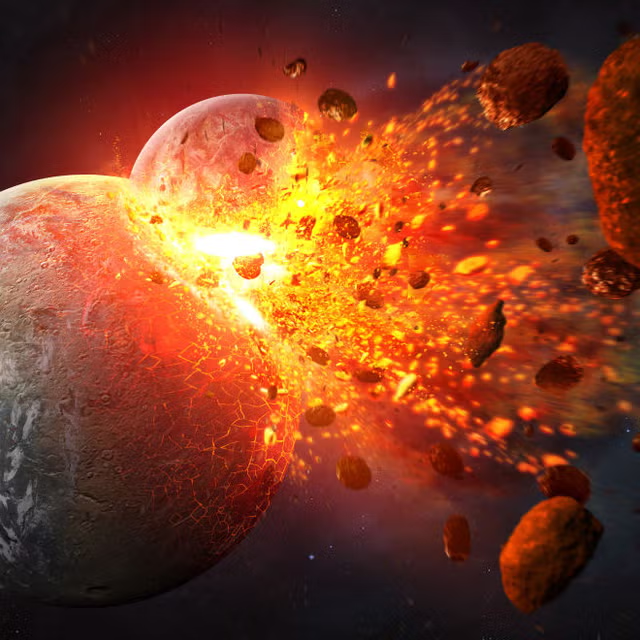
You all must have seen the lunar eclipse which took place recently on 7–8 Sept. The blood-red moon looked so fascinating, right? While watching the eclipse, a question came to my mind, and I hope it came to yours too: How did the Moon form, and why do we only get to see its near side and not the far side? How does it look? In this article, I’ll try my best to answer the queries you all have.
The formation of the Moon has 4 theories which include the Capture Theory, Fission Theory, Condensation Theory, and Giant Impact Theory. Let’s move to the explanation of each:
Capture Theory : It states that the Moon did not form with the Earth. It was formed elsewhere in our solar system, and while passing near Earth or by Earth’s gravitational pull, it got captured. But this theory is surpassed by the Giant Impact Theory as it does not have proper evidence
Fission Theory : It states that the Moon was once a part of the Earth, and due to the high-speed spin of Earth caused by the Sun’s gravity and centrifugal force, some part of Earth broke off, making the Moon. It was suggested in the late 19th century and is one of the earliest hypotheses of the Moon’s origin
Condensation Theory : It states that during the early formation of the solar system, both the Earth and the Moon condensed simultaneously from the same primordial nebula (a cloud of gas and dust), forming as a co-accreting pair.
But all three of these theories are surpassed by the Giant Impact Theory, making the Impact Theory the most accurate with evidence
The Giant Impact Theory
For decades, the suspense of what lies on the far side of the Moon has continued. But have you ever wondered why that side never shows up?
It’s because of Earth’s strong gravity, which keeps the Moon tidally locked. This means we always see the same near side, while the far side remains hidden. But then—how can we explore it?
The far side was first photographed by the Soviet Luna 3 probe in October 1959, which changed our view of the Moon forever.
But before that, let me tell you why we see craters on the Moon.There are mainly two reasons. First, which you may already know, is asteroid and meteoroid impacts. When they hit, they cause destruction on the surface, forming craters. Second, in some places, when impacts occurred, volcanic eruptions followed. The flow of lava spread across the surface, leaving certain areas smoother compared to heavily cratered regions.
But what about the far side? Is it the same as the near side? No—it actually has more craters and a much thicker crust, about 30 miles thick. Now the question is—why
But while the impact theory explains how the Moon formed, it does not explain the thick crust of the far side.
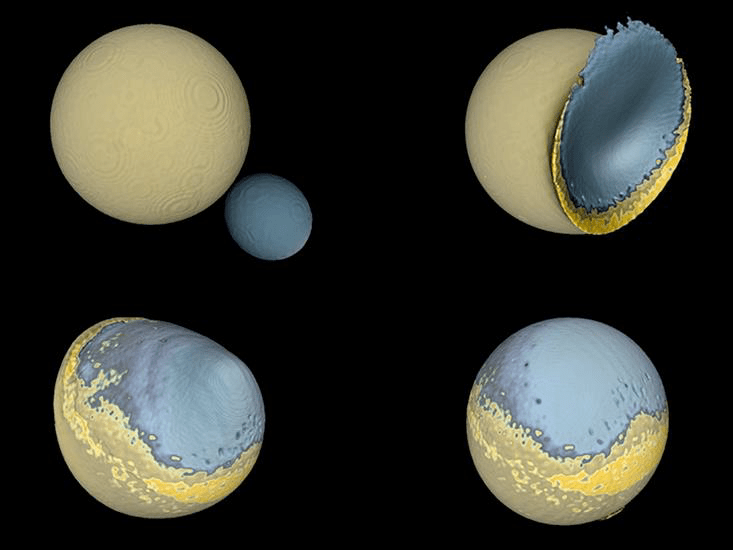
So something unusual must have happened in the past. Do you agree?
This is where supercomputer simulations give us a clue. They suggest that the impact with Theia may have formed two moons instead of one—a larger one (our present Moon) and a smaller companion. Over time, the smaller one may have slowly collided with the larger Moon. Instead of destroying it, the two merged, adding extra material to one side. This would explain why the far side is much thicker and more heavily cratered than the near side.
 Orbital Infinity
Leave a comment