3I/ATLAS: The Interstellar Visitor
On July 1, 2025, astronomers in Chile noticed something incredible. Using NASA’s ATLAS system, they spotted a faint object flying across the sky at 209,000 kilometers per hour! This wasn’t an ordinary comet—it was 3I/ATLAS, the third known object from outside our solar system to visit us.
Almost immediately, 3I/ATLAS surprised scientists. It behaves differently from normal comets and is helping us learn new things about space!
Looking Closer at 3I/ATLAS
Size and Composition
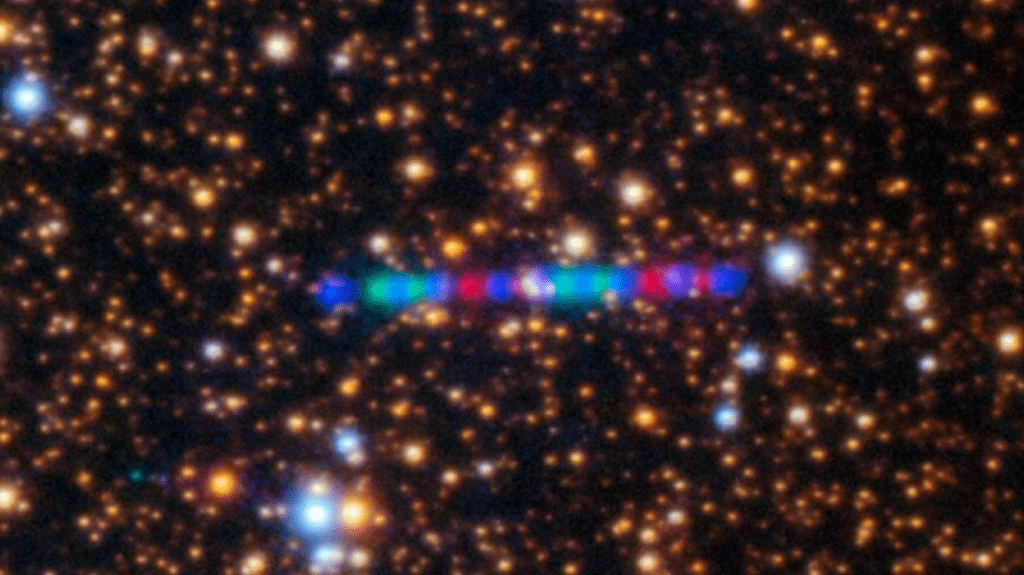
Hubble telescope images show the comet’s core is between 320 meters and 5.6 kilometers wide. Measuring it is tricky because the bright cloud of gas and dust around it hides the solid part.
But the really strange thing is its makeup! Data from the James Webb Space Telescope shows that 3I/ATLAS is mostly carbon dioxide, not water. The CO₂ to H₂O ratio is about 8 to 1, far higher than any comet from our solar system. This means it formed in a very different environment!
Strange Behavior
3I/ATLAS started releasing gas and dust much farther from the Sun than usual comets—6.4 astronomical units away! Most comets wait until they are near Jupiter to start acting up. The early activity is due to carbon dioxide and carbon monoxide, which can turn into gas at very low temperatures.
The Very Large Telescope also saw atomic nickel and cyanide coming from it, showing it’s been through extreme conditions. Its cloud also has a mix of icy and dark materials, similar to distant objects in our solar system.
Where Did It Come From?
An Ancient Comet
3I/ATLAS might be 7 billion years old, much older than our solar system! It formed when the Milky Way was young, in very different conditions from today.
A Traveler Across the Galaxy
Unlike Oumuamua and 2I/Borisov, which came from younger stars, 3I/ATLAS likely comes from the thick disk of the Milky Way, a region with very old stars. Its path points back toward Sagittarius, near the center of the galaxy. Imagine it drifting across space for billions of years before finally reaching us!
How It was Formed
Its high carbon dioxide hints at where it came from. Either it formed in a gas-rich disk around another star, or it spent billions of years in space, losing other ices while keeping CO₂. It probably formed far from its star, in a very cold place.
Some of its isotopes are similar to Earth, showing that even far away, carbon chemistry can be the same!
Its Visit to Our Solar System
Orbit and Observation
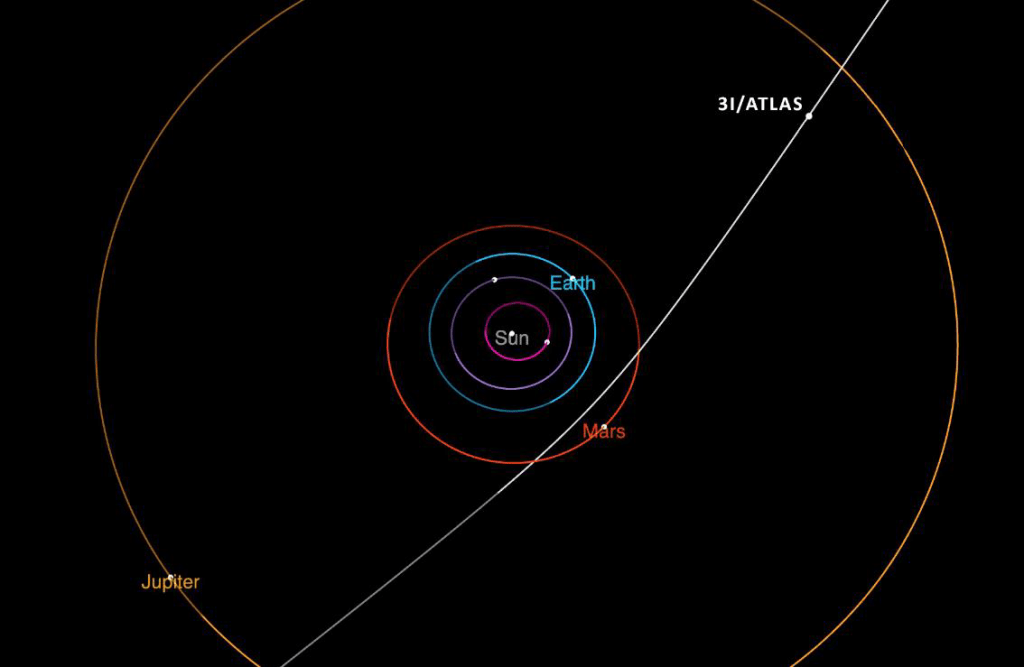
Trajectory of 3I/Atlas. Courtesy to NASA
3I/ATLAS is on a hyperbolic path, meaning it will swing past the Sun once and then leave forever. It reached its
closest point to the Sun on October 29, 2025, just inside Mars’ orbit. For a while, it was on the far side of the Sun, so it was hard to see.
By early December, it appeared in the morning sky—first in Virgo, then Leo—but it was fading fast from magnitude 12–13 to 14+. Astronomers had a short but important chance to study it!
Why It Matters
Several spacecraft, including NASA’s Psyche mission and ESA’s Juice, observed it. The data will help us understand how comets behave, what they’re made of, and how objects from other star systems travel.
Scientists now think interstellar objects like 3I/ATLAS may be more common than we realized. There might always be one hiding in our solar system!
Comparing It to Oumuamua:
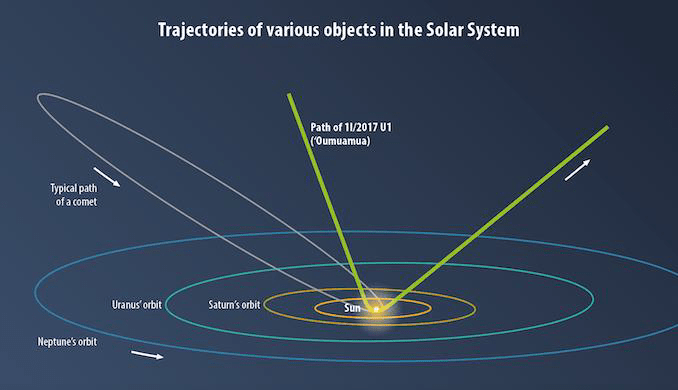
Path of Oumuamua. Courtesy to AstronomyNow
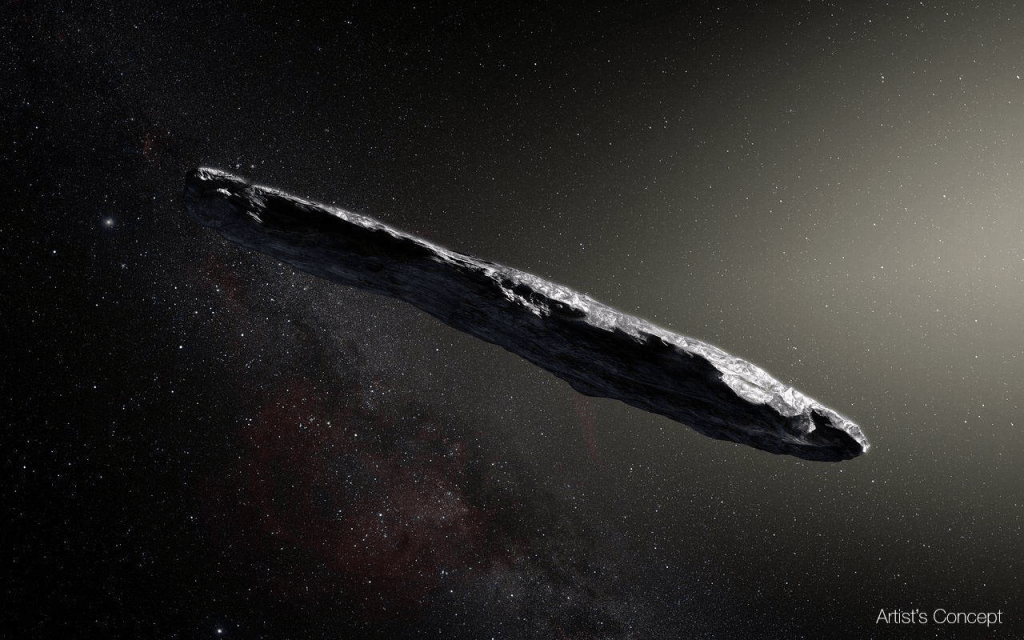
Artist Visualised image of Oumuamua in 2017. Courtesy to NASA.
Behavior: ʻOumuamua was rocky and inactive, while 3I/ATLAS is icy, active, and has a tail.
Size: ʻOumuamua was only ~100 meters; 3I/ATLAS could be up to 5.6 kilometers!
Origin: ʻOumuamua came from younger stars in the thin disk, while 3I/ATLAS is ancient, from the thick disk.
About the Alien Theories
Some people, including Harvard physicist Avi Loeb, suggested 3I/ATLAS might be alien technology! They imagined it could even be a probe.
But the evidence says otherwise. NASA scientists confirmed: “It looks like a comet. It does comet things.” Hubble, JWST, and the Very Large Telescope all saw natural gas, dust, and emissions. Even Loeb admits 3I/ATLAS is almost certainly natural.
Why 3I/ATLAS Is Exciting
Studying this comet is a rare chance to learn about the early galaxy. Its chemistry and age give clues about how planets formed billions of years ago. Its similarity to Earth’s isotopes suggests that carbon chemistry might be common in the galaxy.
It also shows that planetary systems throw debris into space, creating a whole galaxy of wandering objects. With future telescopes like the Vera C. Rubin Observatory, we might soon see dozens more interstellar visitors.
3I/ATLAS may only be here for a short time, but the lessons it teaches will last for decades. The universe is full of surprises, and this little comet is proof!
 Orbital Infinity
Leave a comment