Again, as we roll back to the series of theorized endings to the universe, our next stop is the Big Crunch. Although it’s a heavily debated theory, as most argue that the ‘Big Freeze’ (Heat death) is much more likely to occur, some scientists argue that there can be a possibility of Big Crunch, if there’s a case of fluctuation in Dark energy
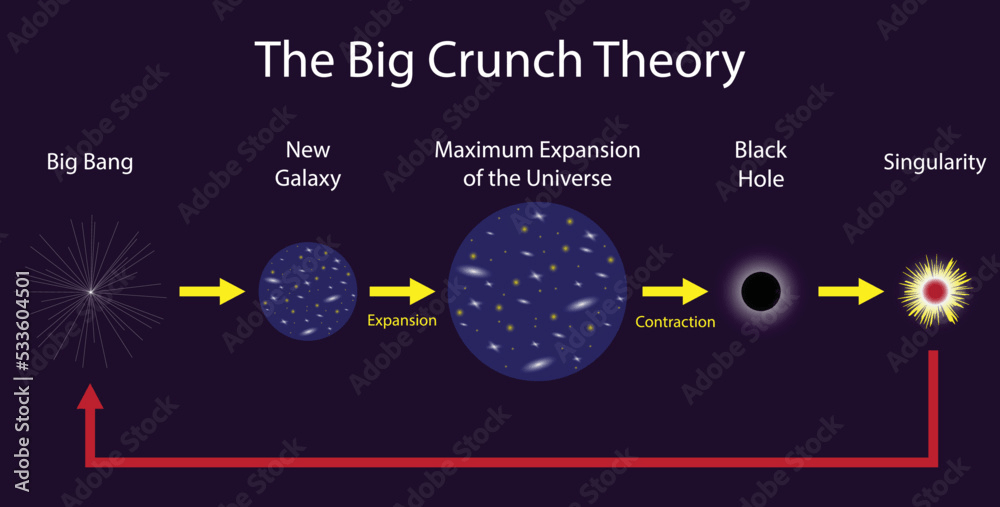
First, let’s clear one question: What is the Big Crunch? And why such an odd name for literally the end of the universe? Well, according to this hypothesis, the Big Crunch will occur when the universe stops expanding, but will contract instead by falling inwards into a very hot, highly dense singularity, like the way it was at the beginning of the Big Bang, so in a way it’s crunching inwards, hence the name. Some suggest that this would give birth to a new universe by a ‘new big bang’.
One could argue that gravity is proportional to density. By this logic, a critical limit can be theorised at which point, the gravity is strong enough due to the density threshold to halt the expansion and begin the Big Crunch.
In spite of all this, modern evidence proves that this event is quite unlikely, as the expansion of the universe is accelerating due to the force of dark energy. For the Big Crunch,the expansion would need to de-accelerate in order to contract. Also, dark energy, the unknown force behind the expansion, covers up about 68% of the universe’s total energy and acts as a repulsive force rather than attractive force, which makes the Big Crunch even more improbable.
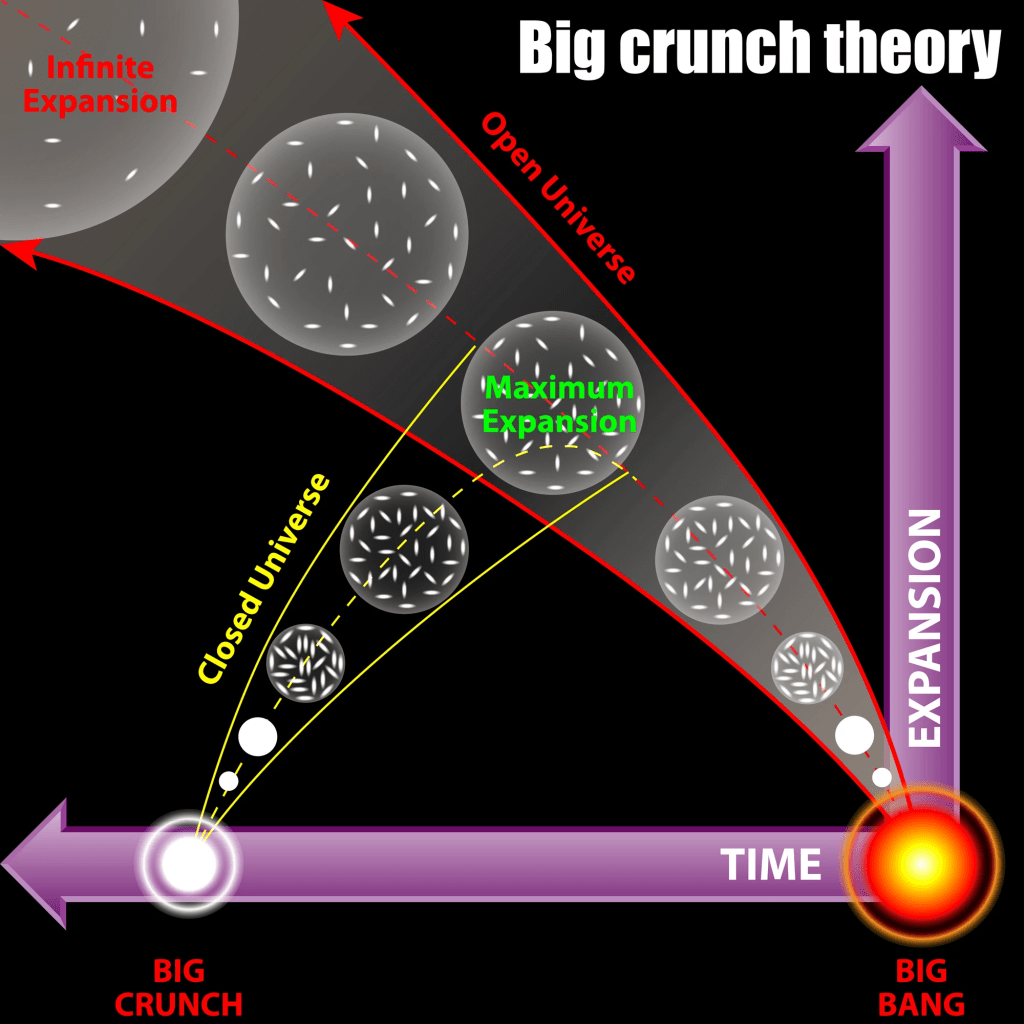
Now let’s discuss the possible fluctuations in dark energy, which can support this theory. Currently, dark energy is treated as a cosmological constant, however, new data for DESI suggests certain variations as well. Certain studies suggest that dark energy’s repulsive force has already reached a peak of energy and is currently slowly weakening. Some suggest that the dark energy might be a quintessence rather than a constant electric field.
However, in the stream of theories emerging in the realm of quantum science and astronomy, most of these theories are heavily debated and would rather be called ‘hypotheses’ as there’s no strong evidence to support any of these other than a pure theoretical or mathematical approach.

 Orbital Infinity
Leave a comment