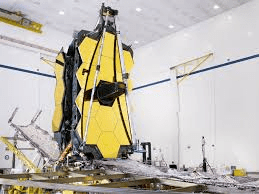
James Webb Space Telescope:
A new era in cosmic discovery, On December 25, 2021, a new chapter in space exploration began. When the Ariane 5 rocket flew from French Guiana, it carried with it the most ambitious astronomical instrument ever built: The James Webb Space Telescope (JWST). This space observatory represents decades of collaborative efforts, technical precision and scientific vision. The main goal is to observe the universe with infrared light and to investigate the origin of galaxies, stars, planets and life itself.
Why JWST was necessary
The Hubble Space Telescope has provided transformative perspectives of the universe for more than three decades, but it has fundamental limitations. Hubble mainly observes visible and ultraviolet light. However, the first and farthest signals from the universe are highly red-shifted by cosmic expansion and are well shifted into infrared spectrums. These old photons cannot be captured by Hubble’s tools, and they are the keys to understanding events such as the formation of the first galaxies.
JWST is designed for observations in near and medium infrared wavelengths with unprecedented sensitivity and resolution. This allows JWST to study the oldest periods of the universe, i.e. within one billion years of the Big Bang, and to study the formation of stars and the composition of the exoplanetary atmosphere through dust clouds. The design of the most advanced space telescope JWST is a performance of modern aerospace engineering.
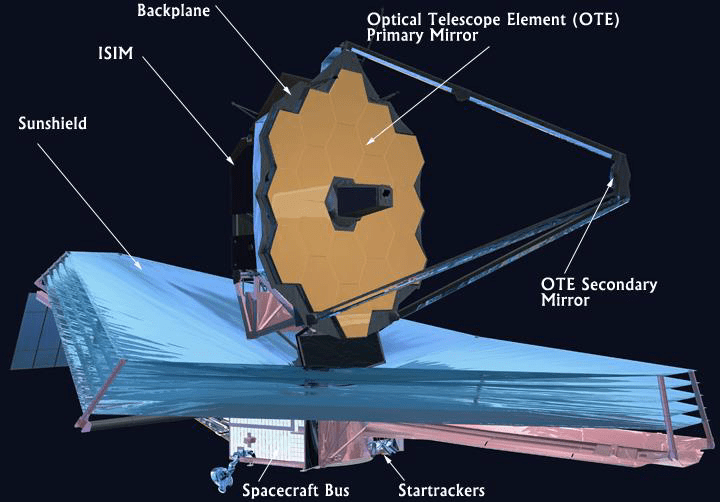
JWST is nearly three times larger than Hubble’s mirror, with a 6.5 metre primary mirror consisting of 18 hexagons of gold-covered beryllium and an area of more than six times its light collection. The size of this significant increase, combined with advanced equipment, makes the JWST the most powerful space telescope to date. Unlike Hubble’s orbit, JWST operates from Lagrange Point 2 (L2) approximately 1.5 million kilometres from Earth. The size of the space telescope has increased considerably, and combined with advanced technology, JWST has become the most powerful space telescope.
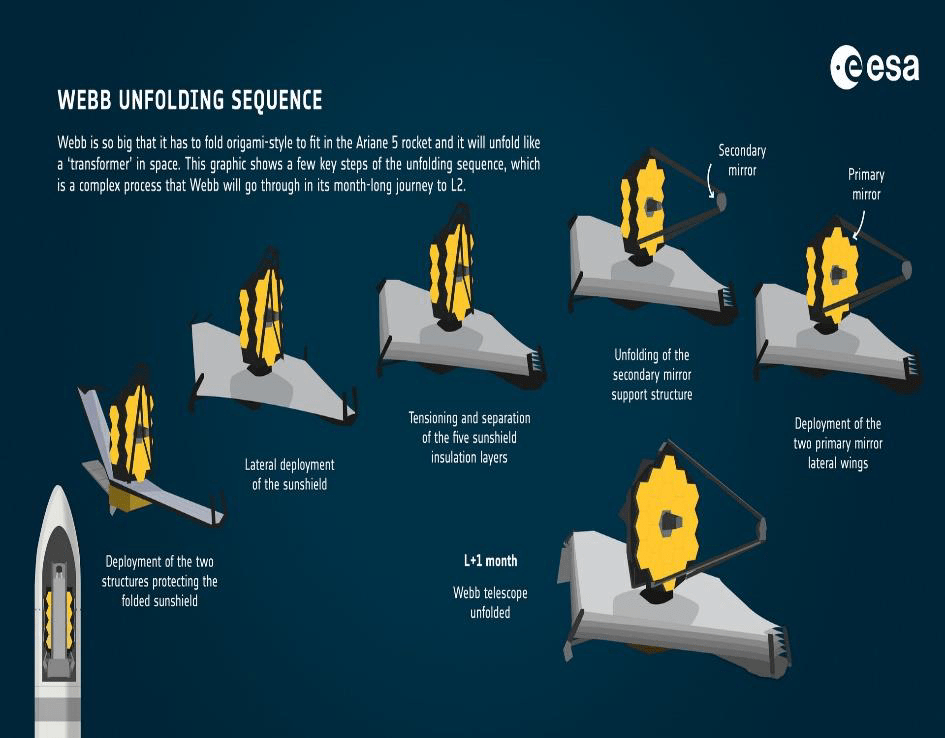
Unlike Hubble, JWST operates from Lagrange Point 2 (L2), about 1.5 million kilometres from Earth. This position protects the telescope from sunlight and the reflection of the Earth’s light, ensuring the very cold temperatures needed for infrared observations.
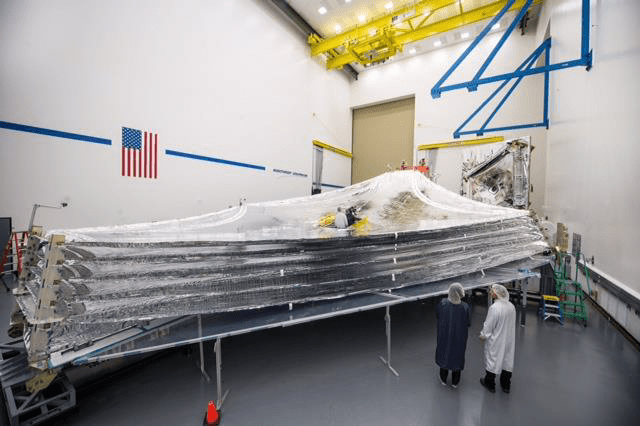
The five-layer tennis court-sized sun shield allows accurate and unobstructed measurement of low infrared signals.
Complex deployment and calibration
Given its size, the JWST must be folded to launch and then deployed autonomously in deep space. This process involved more than 300 single-point failures, including sunshield development, secondary mirror expansion, and mirror segment alignment. Each action requires accurate timing and complete execution. After successful deployment, JWST completed a few months of deployment, which included cooling, alignment and calibration of the instruments.
Once fully operational, the telescope quickly began to generate data that attracted global attention and signalled the beginning of a scientific renaissance.
Observations of major discoveries and scientific highlights of the early universe.
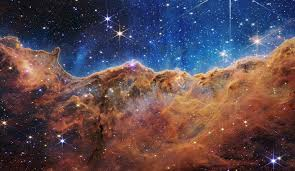
The first full-colour images published by the telescope in July 2022 include the deepest infrared images of the universe ever captured, revealing the countless galaxies in astonishing detail. These images give a view of the structure and composition of the universe that appeared hundreds of million years after its creation. Since then, JWST has discovered extremely distant galaxies, including one known as “MoM z14”, which is thought to have existed less than 300 million years after the Big Bang. This finding extended the boundaries of current cosmic models and raised new questions about the speed with which structures appeared in the early universe.
JWST’s observations of massive galaxies
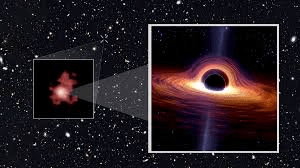
Early black holes discovered massive galaxies that existed much earlier than previously thought possible. Some of these galaxies have the same mass as the Milky Way, but formed within 500 to 700 billion years of the Big Bang. In addition, JWST has found supermassive black holes, some of which appear to have grown rapidly – some of which exceed one billion solar masses – well before traditional models explain such growth. These discoveries challenge the established theories of cosmology and galaxies formation and prompt a re-evaluation of how galaxies and black holes evolved in the early universe.
JWST also brings unprecedented capabilities to the study of extrasolar planets by describing the atmosphere of alien planets. A telescope, known as transit spectroscopy, analyses light passing through the atmosphere of a planet when the planet passes through its host star. The method has already produced detailed atmospheric profiles for some exoplanets, including elements such as water vapour, carbon dioxide, methane and even fog, which are crucial indicators for search for habitability.
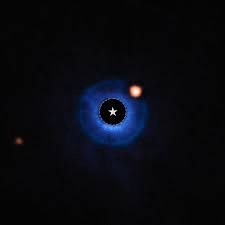
In August 2025, JWST successfully discovered and photographed a young Saturn-mass exoplanet orbiting nearby star TWA 7. This direct imaging of these low-mass objects represents an important advance in comparative planetary science. Contribution to Solar System Science Although JWST’s design places priority on distant, faint targets, it also offers a new fascinating perspective on objects in our own Solar System. These include detailed observations of Jupiter’s aurora, spectral analysis of the components of the Mars atmosphere, and close observations of comets and trans-Neptunian objects, providing new insights into the formation and dynamics of the solar system.
A paradigm Shift in astronomy
Scientific discoveries are emerging rapidly, with JWST producing hundreds of terabytes of high-quality data that are changing our comprehension of the cosmos. Whether it’s on early stellar formation, dark matter distributions, or livable conditions on other worlds, researchers and institutions around the world are presenting findings that contradict preconceived notions.
In addition to transforming astronomy, this information explosion is also altering how scientific collaborations function. Scientists from a variety of disciplines, including cosmology, planetary geology, and exoplanet science, are collaborating to fully utilize the telescope’s interdisciplinary capabilities.
A Joint Victory
NASA, the European Space Agency (ESA), and the Canadian Space Agency (CSA) collaborated globally to create JWST. Its creation involved more than 10,000 scientists, engineers, and technicians from 14 different countries. This global collaboration shows what may be achieved when combined knowledge and a common goal are applied to issues that are larger than any one organization or any nation. Looking at this trend, I hope that Indian Space and Research Organization also joins such multi nation marvels and contributes its name in the history books as a collaborative space agency.
 Orbital Infinity
Leave a comment