Life on Titan
Life on Titan
Life on Mars is obviously one of the hot topics of the world today, but did you know that there’s another celestial body which might hold the potential of developing life? We are talking about Titan, one of Saturn’s 274 moons. It’s also the second largest moon in the Solar system, the first being Ganymede of Jupiter. It’s also bigger than Mercury.
What are attributes which contribute to life on Earth in the first place? Two of them are dense atmosphere and presence of water. Titan, as of now, is the only moon in the Solar system to have a dense atmosphere, and is speculated to have a subsurface ocean. Fascinating, right? It also conducts Earth’s equivalent of the Water cycle.
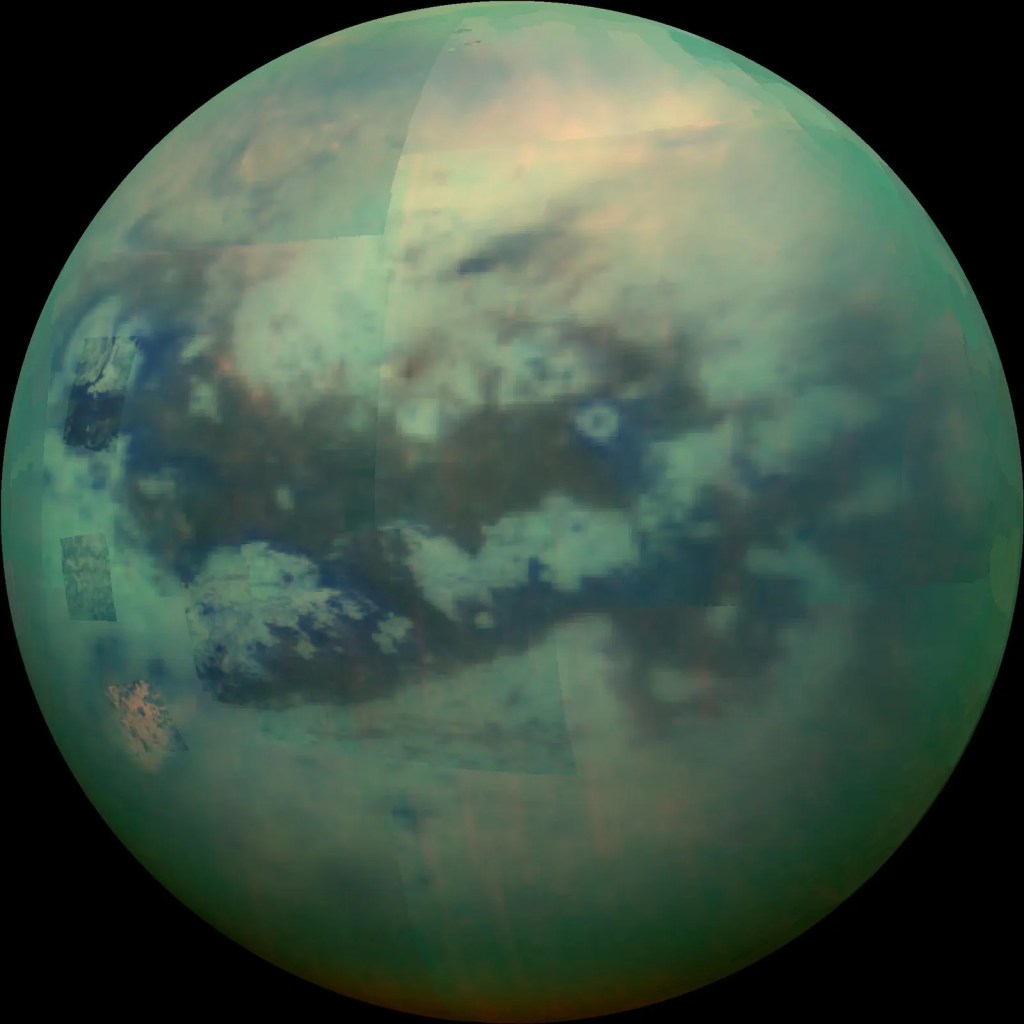
The presence of Methane makes the atmosphere of Mars particularly interesting. Sunlight continuously breaks down CH4. Some source must be replenishing it, otherwise it would have been exhausted a long time ago. But the source is yet to be known. Some scientists have theorised the source to be cryovolcanism. Radio signals measured by ESA’s Huygens probe, during its descent to the surface in 2005, were the reason for the speculation of the presence of an ocean, 55-80 km below icy ground.
Internal structure of Titan
According to one model of Cassini-Huygens mission, there are five primary layers in Titan, the innermost layer is a core of water-bearing silicate rock which expands approximately upto 4000 km. The core is a shell made of water and ice, which is a special type called Ice-VI, that’s only found at extremely high pressures.
The high pressure ice is surrounded by a layer of salty liquid water on the top of which sits an outer crust of water ice. This suggests the possibility of a subsurface ocean hence suggesting the possibility of life on Titan.
Atmosphere of Titan
Similarly like Earth, Titan also possesses a Nitrogen-dominant atmosphere, in which it’s approximately 95% while methane forms a mere 5%. But, even though CH4 constitutes a mere 5% of the atmosphere, it’s one of the major reasons for the speculations of life present in Titan. In its atmosphere, CH4 and Nitrogen molecules are split due to the ultraviolet light of the Sun and the high energy particles accelerated in the magnetic field of the Sun. Recombinations of these molecules create a variety of organic substances which include nitrogen, oxygen and other chemicals which are necessary to sustain life.

One more interesting thing to note is, Titan’s surface temperature happens to be 1.5 barr, i.e. 50% higher than that of Earth. The temperature however, is extremely cold, as free oxygen is impossible at 94K (-179°C). Hence, this is one inconsistency in the theory of possibility of life on Titan.
 Orbital Infinity
Leave a comment